
The Ancient Fighting Arts of the Tamil People
History, Philosophy, and a Legacy That Shaped Combat Traditions Across Asia and the World
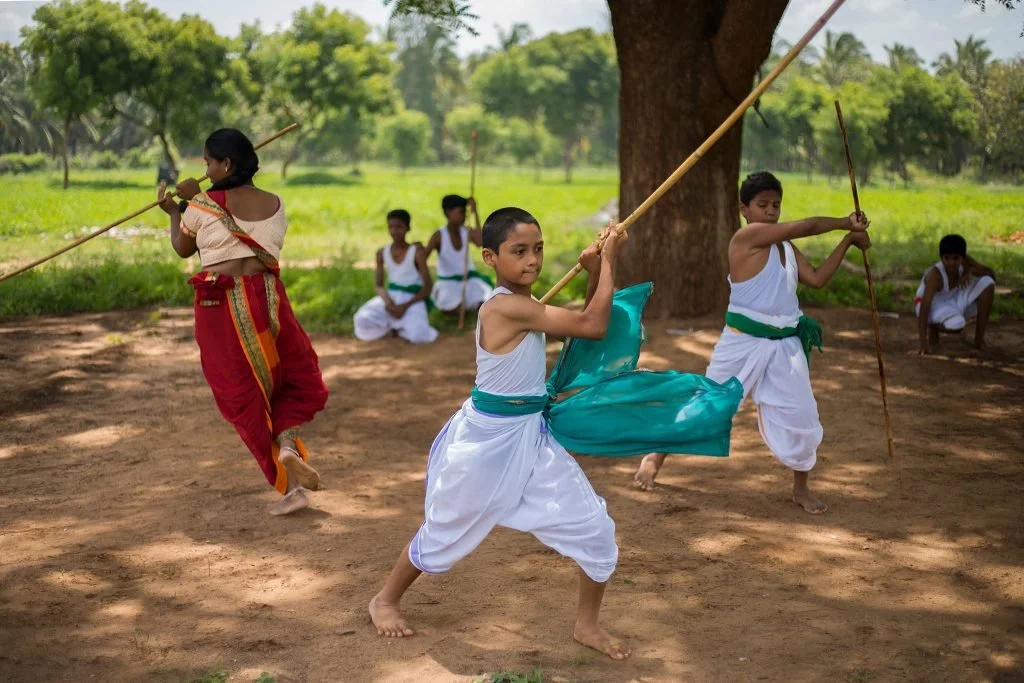
Ask most people where martial arts come from and you'll hear Japan, China, maybe Korea. Rarely does anyone mention the Tamil-speaking lands of southern India — and that's a strange gap, given how old and how far-reaching the fighting traditions of ancient Tamilakam actually were. These weren't just combat techniques passed between warriors. They were living systems that wove together medicine, movement, philosophy, and devotional practice, carried forward through family lineages, temple festivals, and the kind of palm-leaf manuscripts that take a scholar's patience to decipher. The world hasn't paid much attention to Tamil martial arts. It probably should have.
Origins: A Martial Culture Rooted in the Sangam Age
The written trail starts with Sangam literature — the classical poetry and prose of the Tamil world, dated roughly between the 4th century BCE and the 3rd century CE. What those texts describe isn't a warrior class set apart from society, but something more thorough: a culture in which martial training was simply expected. Every warrior learned to handle arms and horses, and mastered at least two weapons. [5] Those who fell in battle weren't mourned as casualties so much as honored as sacrifices — hero stones (nadukal) were raised for the fallen, and the literature treats honorable combat with something close to reverence. [5]
More telling still is a detail buried in the Sangam epic Silappadikaram, composed around the 2nd century CE: it records the commercial trade of Silambam staffs, fighting instruction, and training equipment to foreign merchants. [5] That's not a minor footnote. It tells us that Tamil martial arts had already become an export commodity by the early Common Era — packaged, traded, carried off to other shores.
The three great Tamil dynasties — the Pandyans, Cholas, and Cheras — all made these arts their own. Their armies trained in them. Their courts practiced them. Their kings were celebrated for mastering them. [1]
The Core Arts
Silambam (சிலம்பம்) Staff-based combat using a bamboo weapon sized to the practitioner — typically shoulder height. One of the oldest documented martial arts anywhere in the world, it appears in Sangam texts from at least the 4th century BCE and extends well beyond the staff itself into empty-hand fighting, grappling, and a range of secondary weapons.
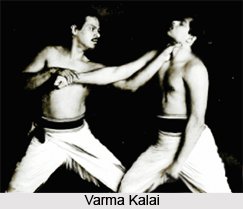
Varma Kalai (வர்மக்கலை) The science of vital points — the varmam — specific anatomical locations where precise strikes can heal, disable, or kill, depending on the hand that applies them. Rooted in the Siddha medical tradition, it treats the body as a network of bio-energetic pathways rather than a simple machine. It is closely related to the marma concept in Ayurveda and to pressure-point arts found in East Asian traditions.
Kuttu Varisai (குத்துவரிசை) Tamil empty-hand combat. Punches, kicks, joint locks, throws, and acrobatics are all part of it, conditioned through yoga, breathwork, and animal-form movement sequences. It functions as a stand-alone art and as the unarmed backbone of Silambam training.
Adimurai (அடிமுறை) A striking system — punches, kicks, basic blocks — practiced primarily by the Kallar and Nadar communities of southern Tamil Nadu. Its non-lethal form, Adithadi, served as a foundational combat system under the Chola and Pandya kingdoms.
Malyutham (மல்யுத்தம்) Traditional Tamil wrestling: throws, pins, joint manipulation. The same grappling logic found in wrestling traditions across the subcontinent, expressed here in Tamil form.
Kalaripayattu — Southern Style Though Kalaripayattu belongs primarily to Kerala, scholars widely accept that the southern style was shaped by sustained contact with Tamil martial arts — particularly Varma Adi and Adimurai — during the long centuries of conflict and exchange between Tamil and Malayalam-speaking kingdoms.
Varma Kalai and the Science of the Body
If one art distinguishes Tamil fighting traditions from almost everything else in the global martial canon, it's Varma Kalai. The art is built around approximately 108 vital points on the human body — locations where the life force (prana) moves through in predictable pathways. Strike them correctly in a fight and you can incapacitate an opponent; manipulate them differently in a clinical setting and you can relieve pain, restore function, treat injury. [4] The same knowledge, the same hands, the same body of learning — applied according to the situation.
This isn't mysticism dressed up as medicine. The varmam points map to actual anatomical intersections: nerves, blood vessels, muscle, bone — places where disruption of normal function produces predictable and repeatable physiological effects. [4] The tradition is attributed to the Tamil Siddhas, the physician-philosophers of the Dravidian south, and has been transmitted through oral teaching and palm-leaf manuscripts for a very long time. [4]
Scholars who study this material have noticed something striking: the Tamil varmam system and the Chinese framework of qi circulation, acupuncture meridians, and the pressure-point striking art called Dim Mak overlap in ways that are difficult to dismiss as coincidence. Whether that represents independent discovery, cross-cultural diffusion through Buddhist networks, or some combination of the two is still debated. [4] What's clear is that Western analytical frameworks — which tend to put medicine in one box and combat in another — struggle to make sense of Varma Kalai, because the art refuses to occupy only one box. The healer and the fighter are the same person. That inseparability isn't incidental; it's the whole point. [4]
The Spread of Silambam: Trade, War, and Diaspora
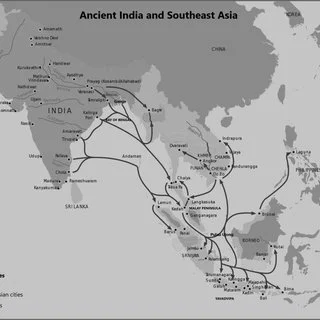
Tamil traders were traveling long distances well before the Common Era — to the Arabian Peninsula, Rome, Egypt, Southeast Asia, and China. They carried spices and pearls and silk. They also carried culture, and Silambam was among the things that traveled with them. [25]
4th Century BCE onward Silambam is documented in Sangam literature. In the port city of Madurai, bamboo staffs are traded alongside swords, pearls, and armor to merchants from abroad. [2]
2nd Century CE The Silappadikaram records the commercial sale of Silambam instruction and equipment to overseas traders — suggesting not a one-off curiosity but an established market for the art. [5]
5th–6th Century CE Bodhidharma — attributed by Indian and Southeast Asian tradition to the Pallava royal lineage of Kanchipuram, Tamil Nadu — travels to China. He is associated with transmitting breathing practices, movement disciplines, and possibly Silambam techniques to the Shaolin monastery, which later became the center of Chinese martial arts. [11, 19]
15th Century CE Tamil Indian communities on the Malay Peninsula are documented practicing Silambam — very likely a continuation of a tradition stretching back well before the founding of Melaka. [27]
18th–19th Century CE Tamil warriors including Veerapandiya Kattabomman and the Maruthu brothers make use of Silambam in their campaigns against the British East India Company. The British subsequently ban the practice — which tells you something about how seriously they took it. [2, 27]
Colonial Era to Present Banned in India, Silambam survives in the Tamil diaspora of Malaysia and Sri Lanka. After independence in 1947 it finds its way back. Today it is the most widely practiced Indian martial art in Malaysia. [27]
Bodhidharma and the Question of Asian Martial Origins
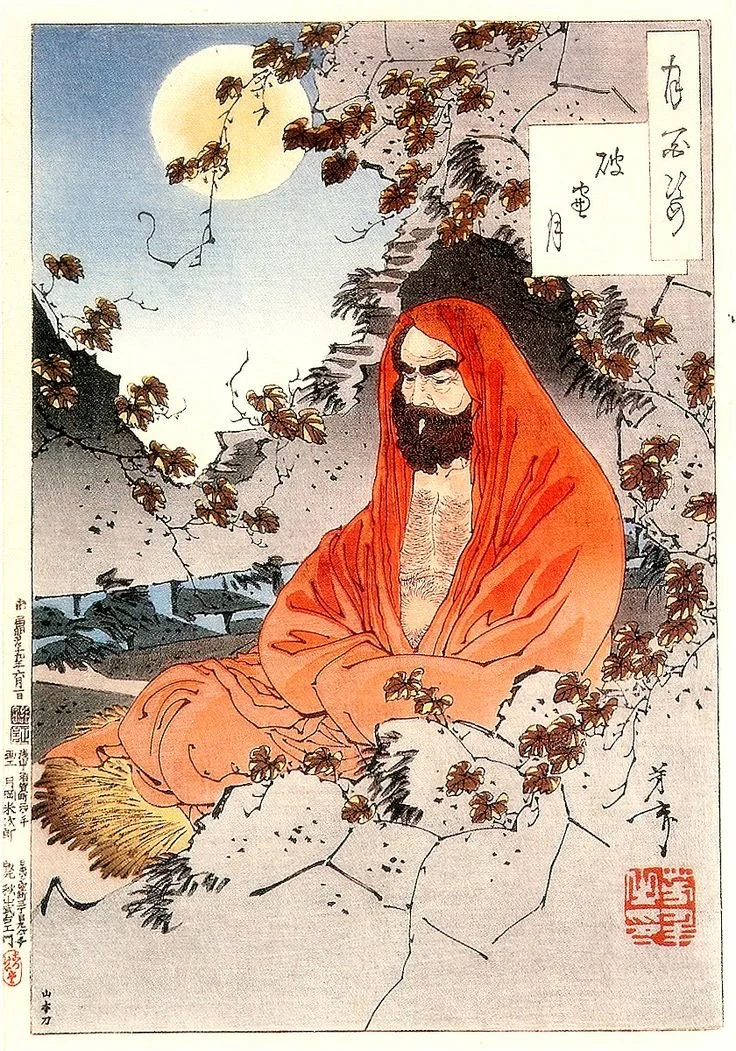
No figure connected to Tamil martial arts carries more weight — or more controversy — than Bodhidharma. The 5th–6th century Buddhist monk is credited in traditional accounts as the founding patriarch of Chan (Zen) Buddhism in China and as the source from which Shaolin Kung Fu ultimately flows. According to Indian and Southeast Asian traditions, he was the third son of the Pallava king of Kanchipuram, which puts his childhood in present-day Tamil Nadu, right in the heartland of Silambam, Varma Kalai, and Kuttu Varisai. [11]
Chinese sources describe him as "the third son of a great Indian king" and "a South Indian." Scholar Tsutomu Kambe has argued that the Chinese characters representing his kingdom correspond phonetically to "Kanchipuram." [11] Tibetan sources also place him in the south of India. Japanese tradition, by contrast, has sometimes identified him as Persian — a reminder that Bodhidharma's biography has always attracted competing claims.
On the martial arts question, the picture is genuinely complicated. The classic account holds that Bodhidharma arrived at Shaolin to find the monks physically wrecked by long periods of seated meditation, and introduced a set of exercises — the Yijin Jing, or Muscle-Tendon Change Classic — that became the seed of Shaolin Kung Fu. But historians including Tang Hao, Xu Zhen, and Matsuda Ryuchi, have pointed out that the Yijin Jing appears to be a 17th-century text, not an ancient one, and that there is evidence the Shaolin monks already had some martial training before Bodhidharma's arrival. [19]
What remains credible is this: a man who grew up in a Tamil royal court — surrounded by Silambam, Varma Kalai, and Kuttu Varisai as living traditions — could very plausibly have introduced South Indian physical disciplines, breathing practices, and structured movement exercises to Chinese monks who had nothing comparable. Whether that constitutes a formal "transfer" of Tamil martial arts to China is a question scholars argue about. What's less contested is the broader pattern: Indian martial philosophy, carried along trade and pilgrimage routes by Buddhist monks, played a meaningful role in shaping the fighting traditions of East Asia. [4, 26]
"The knowledge of marma was circulated by Buddhist monks to other Asian countries, especially China, Korea, and Japan, where they further developed other traditional martial arts." — Research cited in Academia.edu — Varma Kalai studies [4]
Influence on World Martial Arts
China The Shaolin lineage's connection to Bodhidharma links Chinese martial arts, however indirectly, to South Indian heritage. The dim mak pressure-point tradition runs parallel to Tamil Varma Kalai in ways that are hard to explain without contact. The meridian system of Chinese medicine maps closely onto the Tamil varmam network. [4, 7]
Japan & Korea Judo, karate, and Korean martial arts descend from Chinese systems that were shaped in part by Indian Buddhist monks. Pressure-point techniques in Japanese jujutsu echo the logic of the varmam tradition. [4]
Malaysia & Singapore Silambam has been practiced in Malaysian Tamil communities since at least the 15th century, probably longer. It's performed at cultural festivals and taught in Tamil diaspora schools, and remains the most celebrated Indian martial art in the country today. [27]
Philippines Arnis/Kali/Escrima — the Filipino stick-fighting tradition — shares enough structural features with Silambam (the centrality of staff and blade, the footwork patterns, the way weapons inform the whole training progression) to prompt serious comparative scholarship. [21, 7]
Indonesia Pencak Silat shares bamboo staff techniques with Silambam. Scholars generally attribute this to centuries of sustained maritime trade and cultural contact between Tamil Nadu and the Indonesian archipelago. [21]
Middle East & Egypt The Silambam staff was traded to Egyptian, Greek, and Roman merchants, and the art's influence spread from there into the Middle East, North Africa, and Europe through those same commercial networks. [2]
As the Australian National University's South Asia Research Institute puts it: "Historically, this martial art has influenced and been influenced by various other martial arts traditions across Asia. The use of bamboo staffs in Silambam bears resemblance to techniques found in Filipino Arnis and Indonesian Pencak Silat. This similarity reflects a broader martial heritage shared through historical trade routes and cultural exchanges between India and Southeast Asia." [21]
Suppression, Survival, and the Modern Revival
Tamil martial arts did not come through the colonial period unscathed. When the British East India Company consolidated its hold over southern India in the late 18th and early 19th centuries, arts like Silambam were seen not as cultural heritage but as operational threats. The Company had good reason to feel that way — Silambam had been a practical weapon of Tamil resistance against British forces, wielded by commanders like Veerapandiya Kattabomman and the Maruthu brothers. Banning it was a strategic move. [27, 30] Practitioners responded with ingenuity: in some areas, training reportedly continued disguised as agricultural work, with sugarcane stalks standing in for bamboo staffs whenever British officials were around. [30]
In Malaysia and Sri Lanka, where the Tamil diaspora had taken these arts, practice continued more openly. After Indian independence in 1947, revival efforts slowly gathered pace. Silambam is now taught in Tamil Nadu schools and universities and recognized by the state government as part of the official cultural heritage. In 2022 the World Silambam Association was granted Special Consultative Status with the United Nations. [2]
Varma Kalai is in a more precarious position. It survives in small family schools and a dwindling number of traditional lineages in southern Tamil Nadu and Kerala. Kuttu Varisai appears with growing frequency in integrated South Indian martial arts programs. Both arts face the challenge common to any embodied knowledge: when a master dies without trained successors, that knowledge doesn't decline — it disappears. Within a generation.

What Makes Tamil Martial Arts Distinctive
Three things set Tamil fighting arts apart from most of what else exists in the world's martial history.
The first is the integration with medicine. In no other major tradition is the fighter and the healer so thoroughly the same person. A Varma Kalai master doesn't switch hats between the training ground and the clinic. The knowledge is unified: the same point struck with intent to disable in combat is the same point stimulated with intent to heal in practice.
The second is the connection between martial training and performance, and between performance and religion. Silambam is a regular feature of Tamil festivals, practiced as ritual spectacle alongside classical dance. Kuttu Varisai shares movement vocabulary with Bharatanatyam — the postures, the footwork, the dynamic oscillation between stillness and explosive action. [7] For the people who developed these arts, the martial and the devotional occupied the same space. They weren't separate things that happened to resemble each other.
The third is the documentary record. Many ancient martial arts rest on oral tradition and retrospective claim. Tamil arts are supported by a continuous literary record stretching from at least the 4th century BCE to the present — Sangam poetry, medieval epics, royal inscriptions, colonial administrative records, and modern academic fieldwork. For a tradition of this antiquity, that's an unusually legible history.
Conclusion
The fighting traditions of ancient Tamil Nadu are among the oldest documented martial arts in human history. They shaped the warriors of a civilization that lasted millennia, traveled with Tamil merchants and Buddhist monks across trade routes that connected India to China, Southeast Asia, the Middle East, and beyond, and left traces — however contested — in the martial cultures of a dozen different peoples.
They survived colonial suppression through diaspora communities and quiet defiance. They are being revived now by practitioners, scholars, and Tamil cultural organizations across the world. For anyone who wants to understand where martial arts actually come from, these traditions aren't a footnote at the back of the story. They're closer to the beginning.
Sources & References
[1] Robintobi. "Exploring the Rich Heritage of Traditional Martial Arts in Tamil Nadu." Vocal Media / Education. https://vocal.media/education/exploring-the-rich-heritage-of-traditional-martial-arts-in-tamil-nadu
[2] "Silambam." Wikipedia (sourced from Tamil Sangam literature, Silappadikaram, and secondary scholarship). https://en.wikipedia.org/wiki/Silambam
[3] "Tamil Martial Arts — Silambam." Tamil Nation. https://tamilnation.org/military/martial
[4] Various contributors. "Varma Kalai." Academia.edu (PDF compilation of peer-reviewed and primary source materials). https://www.academia.edu/7494157/Varma_Kalai
[5] "Martial Arts — International Day of Sports." Tamil Heritage Library. https://telibrary.com/en/martial-arts/
[6] "Varma Kalai." Wikipedia. https://en.wikipedia.org/wiki/Varma_kalai
[7] "Thamizhar Martial Arts." Sangam.org. https://www.sangam.org/taraki/articles/2006/02-10_Thamizhar_Martial_Arts.php
[8] "Adimurai." Wikipedia. https://en.wikipedia.org/wiki/Adimurai
[9] "Kalaripayattu." Wikipedia. https://en.wikipedia.org/wiki/Kalaripayattu
[10] "Ancient Indian Martial Arts." Center for Cultural Heritage of India. https://cultureandheritage.org/2024/02/ancient-indian-martial-arts-exploring-the-spiritual-and-cultural-depths-of-indias-fighting-traditions.html
[11] "Bodhidharma." Wikipedia (drawing on Broughton 1999, Kambe, Zvelebil 1987). https://en.wikipedia.org/wiki/Bodhidharma
[19] "The Master of Martial Arts — A Pallava Prince." Ponniyin Selvan Historical Forum (citing Tang Hao, Xu Zhen, Matsuda Ryuchi). https://ponniyinselvan.in/forum/discussion/18088/the-master-of-martial-arts-a-pallava-prince/p1
[21] "Silambam: Twirling into Tamil Combat Tradition." ANU South Asia Research Institute / School of Culture, History & Language. https://sari.anu.edu.au/content-centre/article/series/silambam-twirling-tamil-combat-tradition
[25] Dokras, Uday. "Ancient Trade Routes of the Tamilians." Academia.edu. https://www.academia.edu/76070275/Ancient_Trade_Routes_of_the_Tamilians
[26] "Silambam." MAP Academy. https://mapacademy.io/article/silambam/
[27] "Silambam (Tamil Nadu, India)." Traditional Sports. https://www.traditionalsports.org/traditional-sports/asia/silambam-tamilnadu-india.html
[28] "History of Silambam." Persatuan Silambam Malaysia. https://silambammalaysia.org/history
[30] "Silambam: A Convergence of Power and Grace." Center for Soft Power / Indica. https://www.csp.indica.in/silambam-a-convergence-of-power-and-grace/
